


Sandhya Garg — Inside the Studio
How Our Prints Are Made
From a Sketch on a Trip to a Finished Dress — Every Print, Designed Here
Quick Answer
Every print on every Sandhya Garg garment is designed from scratch by Sandhya herself — researched, drawn, sketched, painted, developed in CAD, and then printed at our own printing facility. None of it is bought in from a mill or licensed from a print studio. That's the single biggest difference between what we make and most of what's sold at this price. It's also why a print, once it sells out, doesn't come back: the artwork exists for that run and that run only.
Here is something most shoppers never think about, and honestly there's no reason they would: the majority of printed dresses on the market don't have a designer behind the print. They have a buyer. Mills and print studios produce catalogues of artwork, brands select from them, and the same florals turn up across a dozen labels in a season with slightly different colourways.
That's a legitimate way to build a collection, and it's how a lot of the industry works. It's just not how we work. I studied womenswear at London College of Fashion and worked at Alexander McQueen, Gucci, Liberty London and Alice Temperley before starting this label — and the thing I wanted to keep from all of that was the drawing. So every print here starts on paper.
In This Post
In-House Prints vs Licensed Mill Prints
| Designed in-house | Licensed from a mill | |
|---|---|---|
| Who draws it | The designer | An external print studio |
| Exclusivity | Exists on one label only | Often sold to several brands |
| Lead time | Many days per print, before a single dress is cut | Select and order |
| Scale of print | Drawn to suit the garment it's for | Fixed — the garment adapts to it |
| If it sells out | Gone — limited run, not repeated | Reorderable indefinitely |
Neither approach is dishonest. But they produce genuinely different garments, and only one of them can promise you won't meet your dress at the party.


The Process, Step by Step
A print takes many days before it becomes a fabric, and considerably longer before it becomes a dress. Here is the actual sequence.
Step 01
Travel & research
Every print begins somewhere real. The inspiration comes from travel — architecture, tilework, textiles, gardens, the specific colour of a particular city. Then days of research before anything gets drawn.
Step 02
Drawing, sketching, painting
The artwork is made by hand first — drawn, sketched and painted. This is the slowest stage and the one that can't be shortcut, because everything downstream inherits whatever happens here.
Step 03
CAD development
Hand artwork moves into CAD to build the repeat, resolve the colourways, and set the scale. A print that looks beautiful on paper can fail completely at garment scale — this is where that gets caught.
Step 04
Printing, at our own facility
The finished artwork is printed at our own printing facility rather than sent out to a third party. Fabrics are printed and embroidered in India, where the craft base for this kind of work is deepest.
Step 05
Then — and only then — the dress
This is the part that surprises people: the silhouettes come after the print. Once the right print is on the right fabric, we start working on dress shapes and build the collection around it.
Step 06
Hand finishing
Embellishments are hand-applied, one at a time. Manufacturing happens in our own design studios in the USA and India, with no child labour and no unfair trade practices at any point in the chain.


From starting till the end, the process is all mine. That is the entire point of the label.
— Sandhya Garg
Why This Matters to What You Actually Buy
Process talk is easy to romanticise, so here is the practical version — four things that are true of your dress specifically because the print was made this way.
- Nobody else is wearing it. The artwork isn't licensed to anyone, so the print exists on this label and nowhere else.
- The print fits the garment. Because the dress is designed after the print rather than around a bought-in one, scale and placement are deliberate rather than approximate.
- It won't come back. Runs are limited, and once a print sells out it isn't reprinted. That's a real constraint, not a marketing line — it's why sizes disappear the way they do.
- The craft is visible up close. Hand-applied embellishment and hand embroidery look different in person than machine work does, which is the single most common thing customers tell us after a first order.
The Honest Trade-Off
Working this way is slower and more expensive than buying prints in, and it means we make far less of everything. If you've ever wondered why a size sells out and never returns, or why the collection is smaller than a comparable brand's — that's why. It's a deliberate trade, and it's the one I'd make again. More on the thinking behind it in our approach to sustainable fashion.
From the Studio
A few frames from the work itself — the part of the label that happens long before a dress reaches a rail.


Ten Original Prints · Artisanal · XS to 3XL
Every One Drawn Here
Ten pieces carrying prints that began as sketches — geometry, florals, tapestry and art deco, each developed from scratch.
Geometry & Tapestry — Hand Embroidered


Florals — Drawn, Not Licensed
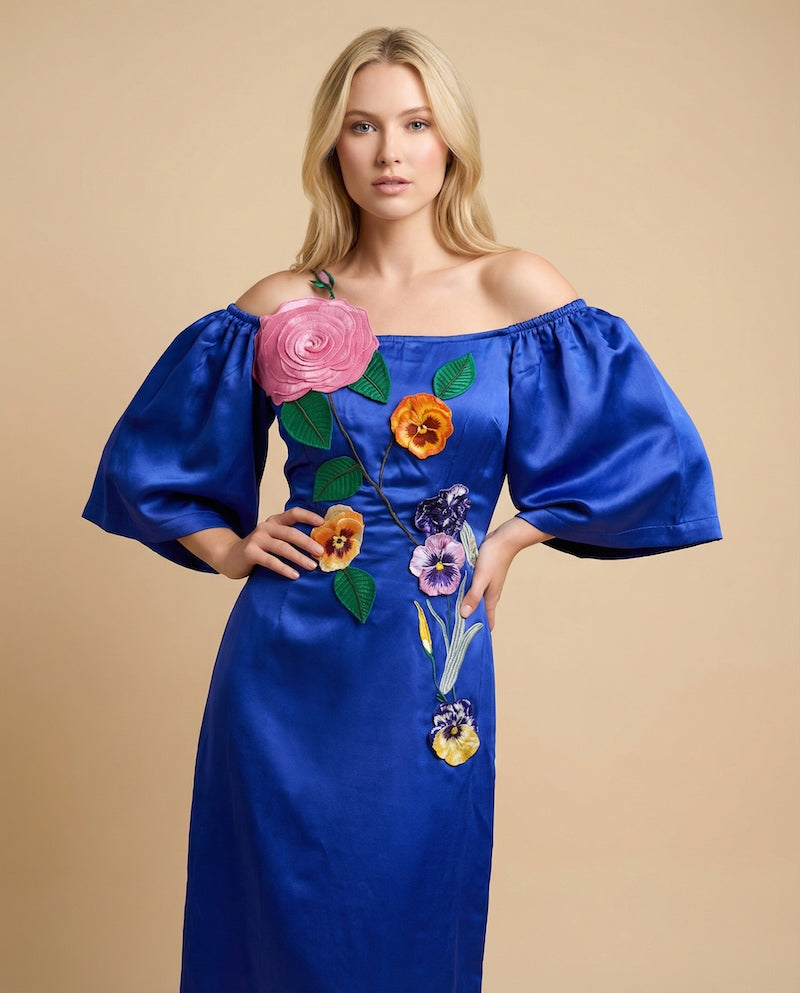


Heritage & Architecture — Prints With a Place Behind Them


All pieces XS · S · M · L · XL · XXL · XXXL (select styles) · Custom sizing available · Free US shipping over $250
Frequently Asked Questions
Are Sandhya Garg prints original?
Yes. Every print is designed exclusively by Sandhya herself — researched, drawn, sketched, painted and developed in CAD from scratch, then printed at our own printing facility. No artwork is licensed or bought in from a mill or print studio.
How long does it take to design one print?
Many days per print, before any garment is designed. Research and hand artwork take the longest; CAD development, repeat construction and colourway resolution follow. Only once the print is finished and printed does the dress design begin.
Where are the fabrics printed and embroidered?
All fabrics are printed and embroidered in India, and garments are manufactured in our own design studios in the USA and India. Embellishments are hand-applied, and we never employ child labour or unfair trade practices.
Will a sold-out print be restocked?
No. Every piece is produced in limited quantities and once a print sells out it does not return. If a print and size are both available and you love it, that's genuinely the moment — we can't reorder it later.
Can I request a custom print or custom size?
Custom sizing is available across the collection, and custom design work is possible — see custom made clothing or email to discuss what you have in mind.
How should I care for a hand-embroidered or printed piece?
Dry cleaning is recommended for embroidered pieces; hand-woven pieces take gentle hand washing or dry cleaning. Full instructions are in our garment care guide.
Keep Reading
Where Prints Begin
Cities Known for Their Colour
The travel behind the artwork, city by city.
The Trade-Off
Sustainable Fashion, Explained
Why we make less of everything.
Make It Last
Garment Care Guide
Caring for embroidery and hand-woven fabric.
The Designer
About Sandhya Garg
Project Runway, McQueen, Liberty London.
Project Runway · Vogue · Marie Claire · XS–3XL
Drawn once. Printed once. Yours.
Sandhya Garg is a Los Angeles boutique creating limited-edition artisanal dresses — every print designed from scratch in-house, every embellishment applied by hand. Sizes XS–3XL, custom sizing available.





Leave a comment